Generative Personalization Engine
Understand every customer. Personalize everything.
Personize GPE turns a shared, governed customer memory into personalized emails, pages, proposals, and playbooks. At the contact level, across every channel.

Customers and signals in. Personalized experiences out.
Trusted by teams at
Why personalization breaks
Most AI personalization is shallow.
Poor personalization typically results from a prompt, a CRM field, or a short context window. Customer data sits fragmented across CRM, email, meetings, websites, support, and documents, so every agent starts from scratch without the full context needed for true generative personalization. That creates four problems:
High cost
AI repeatedly processes large volumes of raw data instead of recalling compact, structured memory. The same account is researched again and again.
Inconsistent personalization
Different agents generate different messages because they do not share the same customer understanding. The story drifts across channels.
Low trust
Teams cannot easily inspect why the AI personalized something, or what information it relied on. Without sources, claims are hard to stand behind.
Limited scale
Personalization may work in small batches, but breaks when a company needs it across thousands or millions of contacts, agents, and campaigns.
The compounding loop
Understand once. Reuse everywhere.
Personize GPE runs as a continuous intelligence loop. Every interaction makes the shared memory sharper, so the next personalized asset is better and cheaper than the last.
Ingest customer data
Connect HubSpot, Salesforce, websites, email history, meeting notes, support tickets, documents, enrichment, and product usage.
Understand the customer
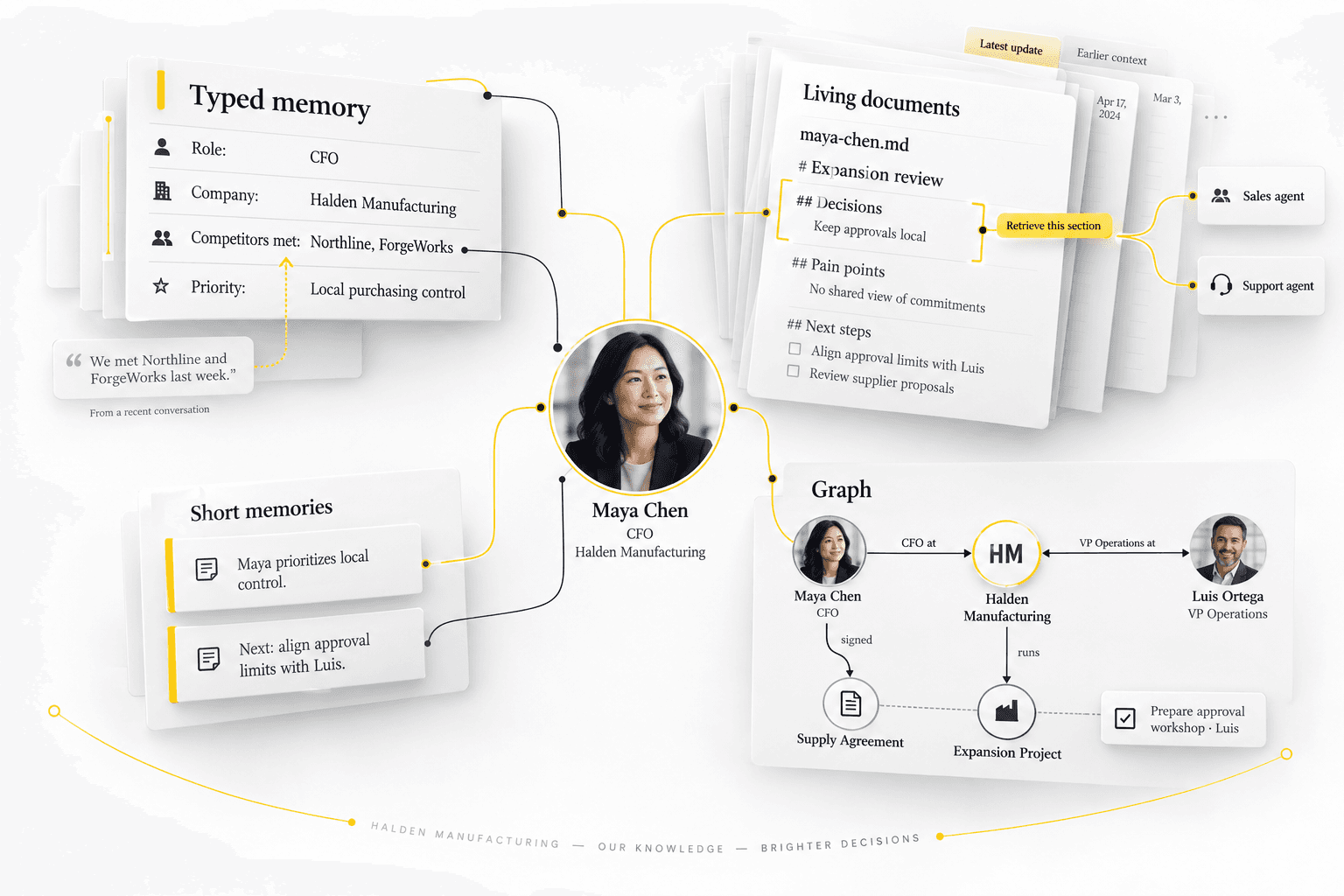
Agents extract roles, priorities, pain points, buying signals, persona, ICP fit, likely objections, and the right message angle.
Store governed memory
Turn understanding into structured properties and atomic facts, each with a confidence score, a source, and a review status.
Activate through GPE
Specialized agents recall the memory to generate emails, landing pages, website sections, playbooks, proposals, and follow-ups.
Learn from outcomes
Opens, replies, meetings, website engagement, sales feedback, and deal outcomes flow back as new signal.
Reuse the improved understanding
The next agent does not start from zero. It recalls what is known, uses the latest memory, and adds new learning back in.
What GPE generates
From customer understanding to personalized action.
One governed memory powers many revenue motions. Move from static, segment-level personalization to dynamic, contact-level personalization across every channel.
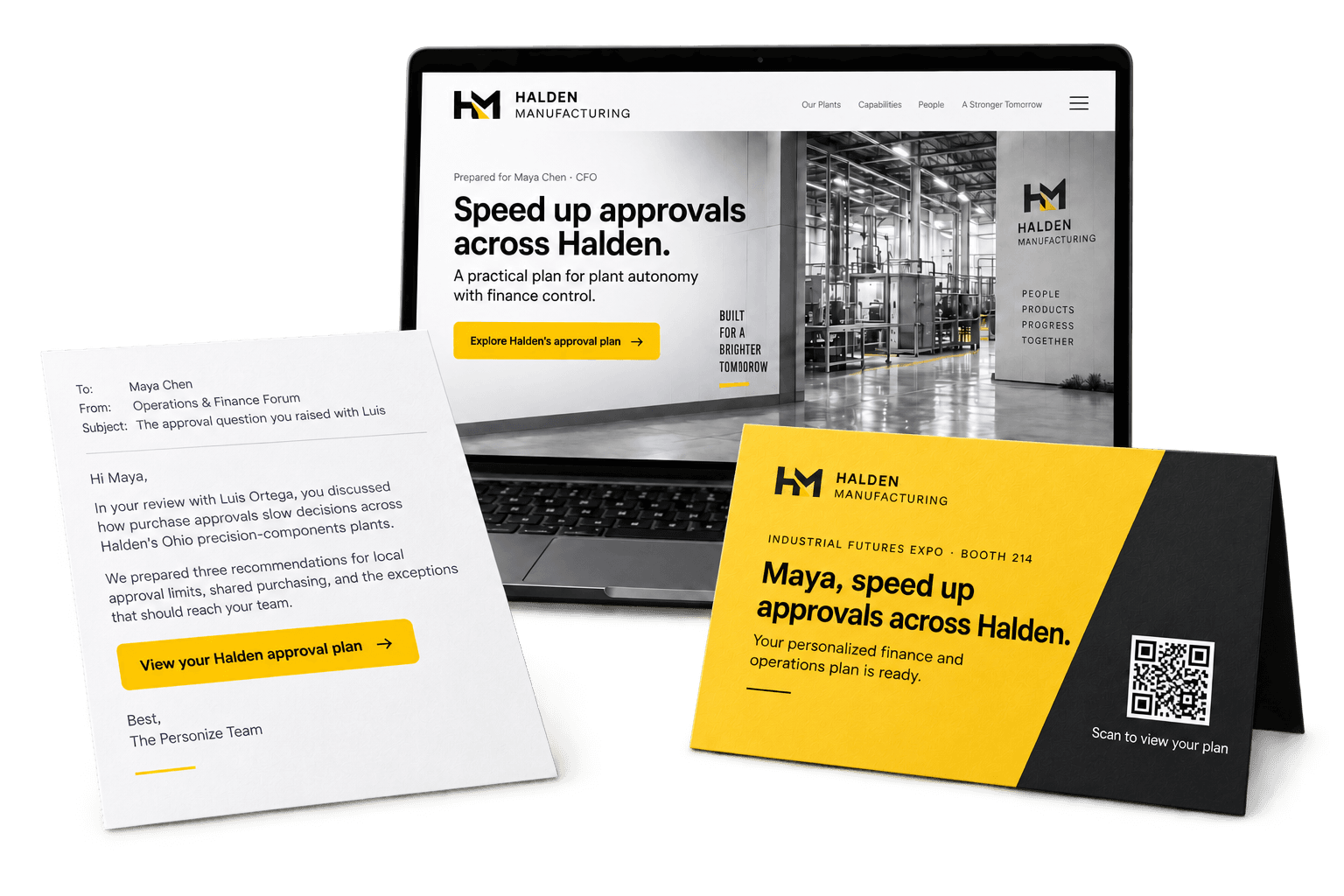
Personalized emails
Cold outbound, warm follow-up, re-engagement, event outreach, and account-based campaigns built from each contact's role, account, and prior engagement.
Memory advantage
The system remembers the context, the previous messages, the objections, and the relevant offer angle.
Personalized landing pages
One page per target account, persona, campaign segment, event attendee, or partner motion, reflecting the customer's business and buying stage.
Memory advantage
Each page can speak to real pain points and proof points, not a generic template.
Website personalization
Adapt existing pages on the fly: hero message, use-case blocks, case-study picks, CTA, and the order of product modules per visitor or account.
Memory advantage
The site becomes adaptive based on what the system already knows about the segment.
Sales playbooks
Rep-facing account briefs before calls: priorities, pain points, discovery questions, recommended pitch, objection handling, and follow-up suggestions.
Memory advantage
Reps get a shared, updated understanding of the account, not a one-time AI summary.
Proposals
Executive summary, problem statement, recommended solution, business case, scope, and personalized proof points tied to the customer's goals.
Memory advantage
Generation connects to everything learned across sales, marketing, and customer conversations.
The difference
Better generation is not enough. You need better memory.
Personize not only generates better content. It is the system that remembers customers better.
Traditional AI personalization
- Prompt-based, one-off generation
- Limited memory, repeated research
- High token cost
- Weak consistency across agents
- Hard to govern and inspect
- Difficult to scale
Personize GPE with Governed Memory
- Memory-based, continuous understanding
- Shared across every agent
- Lower repeated research and AI cost
- Stronger consistency everywhere
- Governed, inspectable, source-backed
- Built to scale, improves over time
Lower cost at scale
Recall compact memory instead of reprocessing everything.
Without memory, AI repeatedly sends large context windows to models, re-reading and re-analyzing the same data on every generation. Governed Memory stores reusable, structured understanding, so the system recalls the right memory instead of reprocessing raw data. At enterprise volume, across many contacts, agents, and channels, that makes personalization dramatically more cost-efficient.
Recall, do not re-research
Agents pull compact, structured memory instead of re-reading raw data on every run. The expensive research happens once.
Compact context, not raw dumps
Governed Memory stores atomic facts and summaries, so prompts carry the right understanding in a fraction of the tokens.
Shared across agents
Every agent works from the same memory. One agent's research becomes every other agent's starting point.
Reuse across campaigns
Understanding accumulates per contact and account, so each new campaign or channel starts ahead, not from zero.
Savings depend on your volume, channel mix, and model choice.
Governed, not just generated
Personalization enterprises can trust.
Enterprise personalization has to be controlled, not only creative. Governance turns memory from a technical feature into an enterprise-ready system where accuracy, privacy, and consistency are enforced.
Trusted sources only
Control which sources memory can be built from, and which fields require approval before an agent can use them.
Confidence and freshness
Every memory carries a confidence score and a timestamp, so stale or low-confidence facts can be flagged, refreshed, or held back.
Source-backed claims
Every personalized claim traces to a source. Teams can inspect exactly why the AI said what it said.
Sensitivity controls
Mark sensitive memory and decide where it can and cannot be used, so personalization never crosses a line it should not.
Agent-level access
Decide which agents can read which memory, and which outputs require a human review before they go out.
Brand and compliance rules
Apply brand voice, legal, and compliance rules across every agent, so generation stays on-policy at scale.
Personalize at scale, with memory that compounds.
Turn customer understanding into personalized emails, pages, proposals, and playbooks across every channel. See what GPE can do with your data.